Read today the
way a scribe would
have drawn it.
Akhet renders today's date in the ancient Egyptian civil calendar, in real hieroglyphs: the wandering year, the seasonal hours on a sundial, and your own name sealed in a cartouche.
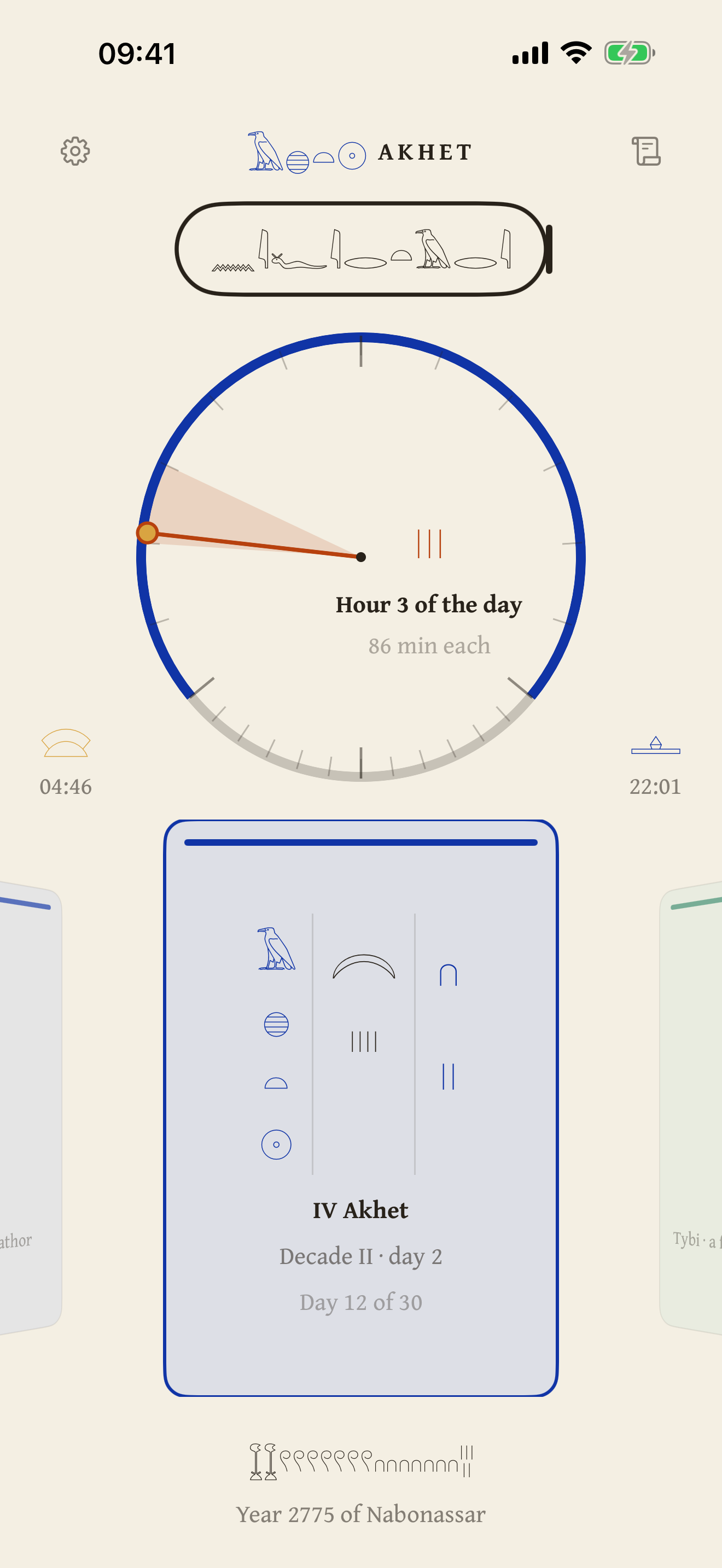
No tabs. No menu. One page.
The cartouche, the sundial, the date and the era year, all on a single screen, off a single engine. Tap a region and it explains itself.
The sundial
A working shadow-clock that mirrors the sun: noon at the top, midnight at the bottom. The day arc carries the season's colour and widens in summer; a gnomon points to the current seasonal hour.
Your cartouche
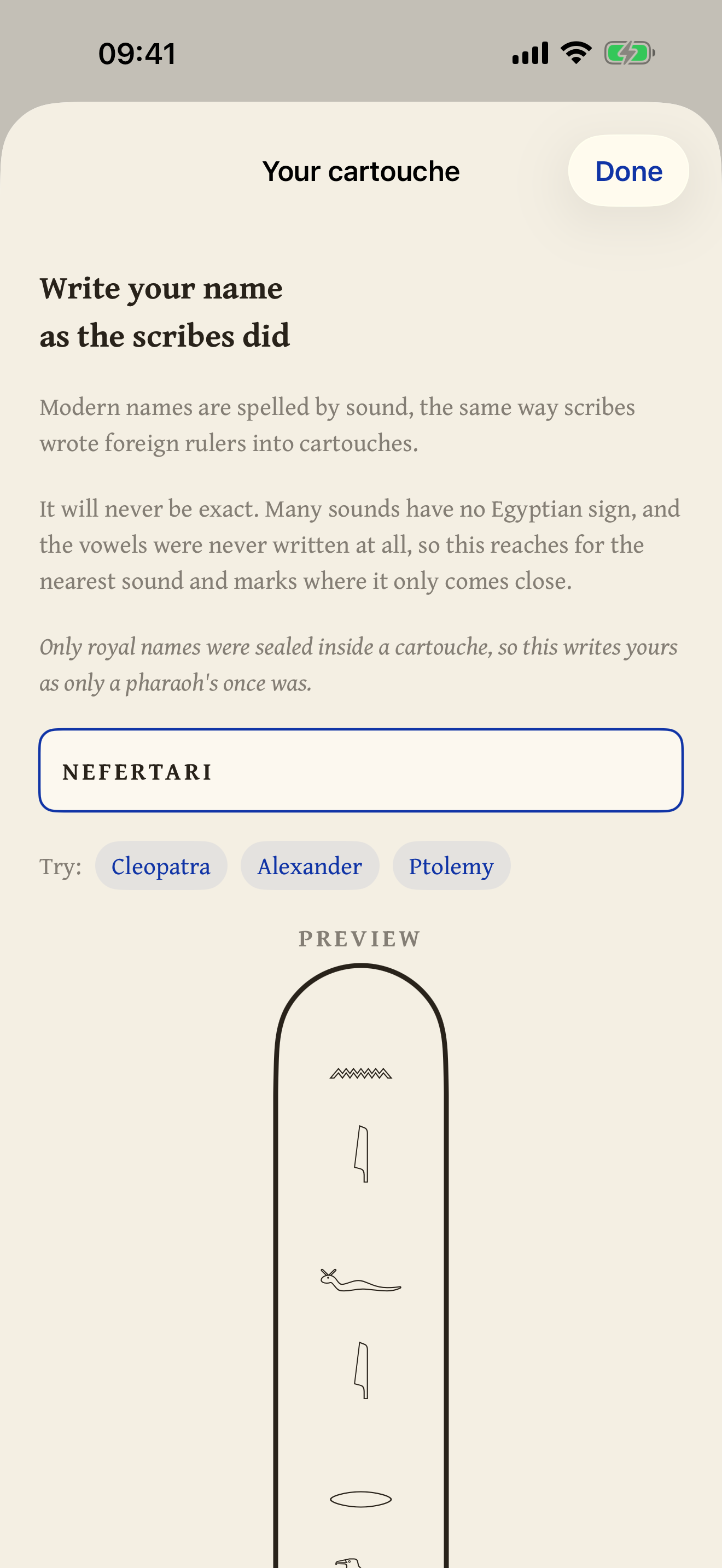
Type your name and it is spelled by sound, the way scribes wrote foreign rulers, Ptwlmys, Qlwpdrt. Tap to edit, choose readings, and hear it read aloud.
The date, in columns
Season, month and day as three ruled columns, the way an inscription divides its text. Twelve 30-day months across three seasons, plus the five epagomenal days.
Seasonal hours
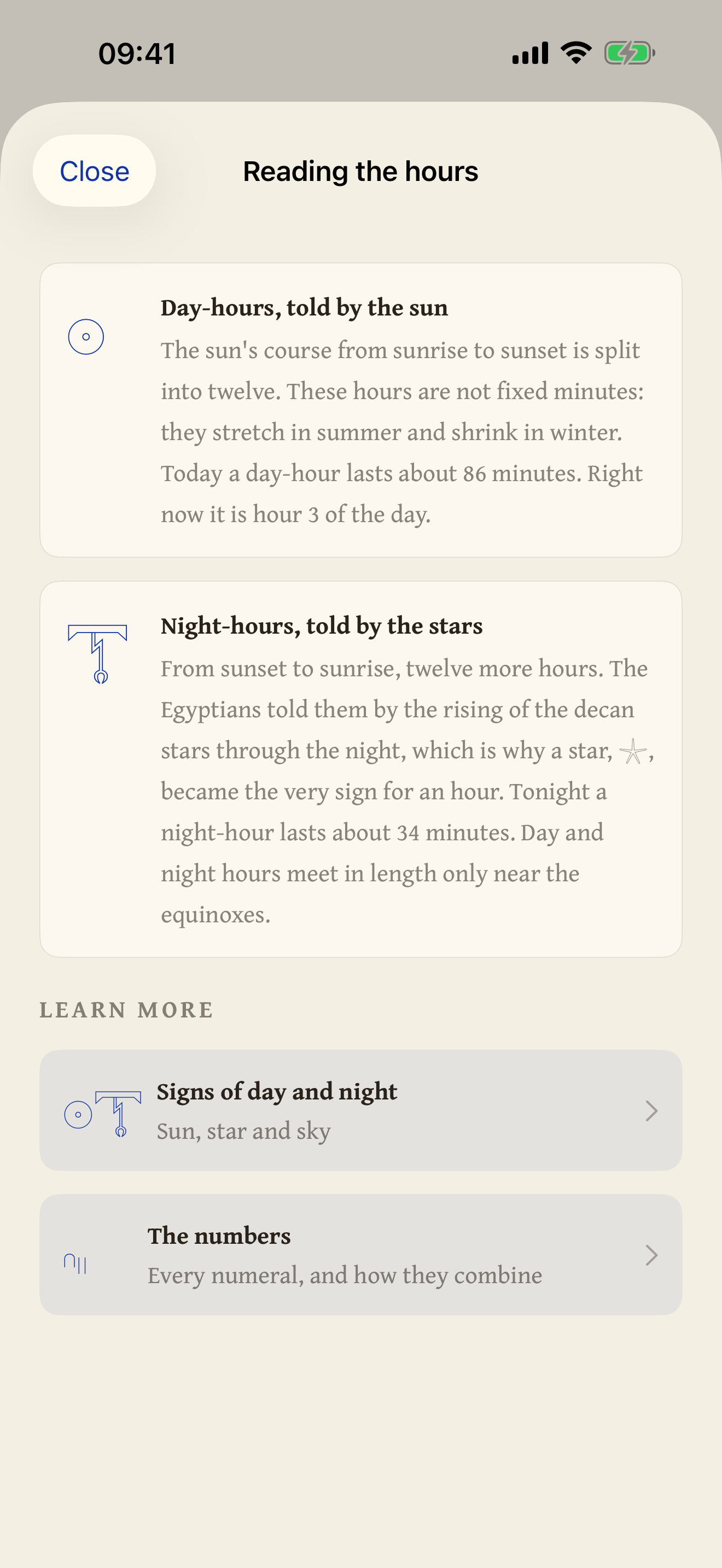
Sunrise and sunset by NOAA/Meeus, twelve hours of day and twelve of night, each stretching and shrinking with the season, in three reckoning modes.
Source-critical
Facts are stated, a tap explains, and where a reading is only approximate it says so. Sources are public-domain egyptology, cited plainly.
Watch & widgets
The live dial and your cartouche as Home- and Lock-Screen widgets and Apple Watch complications, all from the same engine, shared across your devices.
The calendar Egypt actually kept
Day-count arithmetic from the Nabonassar epoch, the Censorinus anchor and the 1461-year Sothic cycle. Because the Egyptians refused to add a leap day, their year slid a full turn against the sun over fifteen centuries: the "wandering year". Akhet draws exactly where today falls.
Spelled by sound, honest about approximation
The script never wrote vowels, and many sounds have no Egyptian sign, so the editor asks "how is it said?" where a letter can be voiced more than one way, lets you mark silent letters, and shows a "Read as" line with a reconstructed pronunciation. The way Champollion broke the code in 1822, told through your own name.
Pharaoh mode
All reading and learning is free. A single one-time purchase unlocks wearing it: the live dial and cartouche as Home- and Lock-Screen widgets and Apple Watch complications, the share-as-image feature, the whole wandering year month by month, and the "Learn more" references.